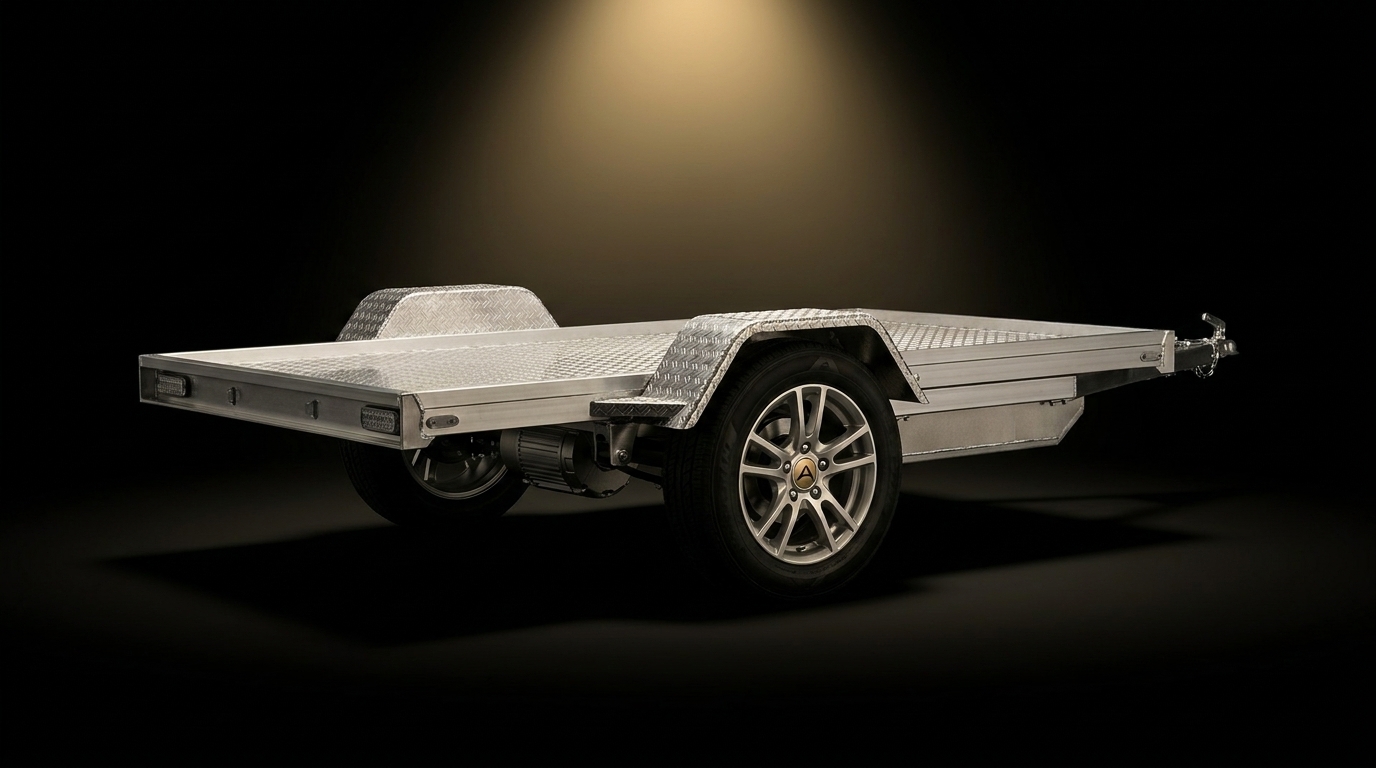
Every Aslin is engineered to deliver the longest possible towing range for its load class. Nothing present that doesn't earn its place.
Long Range · Up to 150 miles
The 3.0 LR is built for the powersports owner — the ATV enthusiast loading up before dawn to beat the desert heat, the motorcycle hauler covering 200 miles of highway to the rally. At 3,500 lb GVWR, it handles single-axle powersports loads cleanly.
A 29 kW continuous axle-mounted motor drives the trailer's own wheels, removing its energy burden from the tow vehicle entirely. The 72.1 kWh LFP battery pack supplies the motor and basecamp power in parallel. Aluminum frame keeps system weight optimized for GVWR headroom.
Long Range · Up to 150 miles
The 5.0 LR steps up to the boat owner and the multi-ATV hauler. At 5,000 lb GVWR, it covers the most common recreational boat weights — ski boats, wake boats, and bay boats — while maintaining the 150-mile towing range standard.
The 36 kW continuous motor draws from a 90.3 kWh LFP battery, scaled proportionally to maintain the same range target while managing a heavier load envelope. Single-axle configuration with independent torsion suspension delivers the stability the weight class demands.
Long Range · Up to 150 miles
The 7.0 LR handles the heaviest recreational loads in the Phase 1 lineup — large bay boats, dual-ATV loads, and heavy powersports equipment. At 7,000 lb GVWR, it fills the gap between weekend recreational hauling and commercial duty without compromising the range standard.
A 42 kW continuous axle-mounted motor is matched with a 108.5 kWh LFP battery — the largest pack in the lineup — optimized to deliver maximum towing range within the physics and weight constraints of this load class.
| Specification | Aslin 3.0 LR | Aslin 5.0 LR | Aslin 7.0 LR |
|---|---|---|---|
| GVWR | 3,500 lb | 5,000 lb | 7,000 lb |
| Towing Range | Up to 150 mi | Up to 150 mi | Up to 150 mi |
| Motor (continuous) | 29 kW | 36 kW | 42 kW |
| Battery Capacity | 72.1 kWh | 90.3 kWh | 108.5 kWh |
| Battery Chemistry | LFP prismatic | LFP prismatic | LFP prismatic |
| Frame | Aluminum | Aluminum | Aluminum |
| Axle Configuration | Single axle | Single axle | Tandem axle |
| Suspension | Torsion, independent | Torsion, independent | Torsion, independent |
| Motor Placement | Axle-mounted | Axle-mounted | Axle-mounted |
| Fast Charge (DCFC) | Compatible | Compatible | Compatible |
| Regen Braking | Yes | Yes | Yes |
| Remote Maneuver | Yes | Yes | Yes |
| Basecamp Power | Yes | Yes | Yes |
| Primary Use | Powersports / ATV | Boats / Powersports | Boats / Heavy Loads |
Hub motors mount inside the wheel and become unsprung mass — mass that the suspension must manage over every bump. Unsprung mass degrades trailer dynamics. The Aslin motor mounts at the axle, inboard of the suspension, where it adds no unsprung penalty. This is the correct architecture for a trailer, full stop.
Lithium Iron Phosphate (LFP) is the chemically stable battery technology — it does not enter thermal runaway under the abuse conditions that a trailer encounters (heat cycling, vibration, partial-state charging). NMC chemistries offer higher energy density but carry thermal risk and a significant cost premium that isn't justified at the trailer operating envelope.
A heavier trailer requires more energy to move — that energy comes from the battery, reducing range. It also reduces GVWR headroom. Aluminum is required on Tier A (3,500 lb) and optimizes performance across all tiers. Every gram saved in the frame is a gram available for payload or battery.
Torsion axle suspension provides independent wheel articulation that reduces body roll, improves tracking stability, and handles load asymmetries that arise from real-world cargo placement. Better stability directly reduces sway risk — the primary failure mode in trailer accidents.
Phase 1 launch targets the Southern California market — the highest concentration of EV tow vehicles and powersports users in the country. Get on the early access list.
Join the Early Access List